Sensory Sprout
Family meal planning for households with sensory-sensitive children
Recipe search assumes flexible preferences. For families with sensory-sensitive children, that assumption causes daily breakdown. This project explores what constraint-first meal planning could look like.
STATUS: Problem validated. Solution in design.
This case study documents discovery-backed diagnosis and design rationale, not proven outcomes.
Problem & Approach
Family Meals Break Down—Despite Effort, Planning, and Intent
For families with sensory-sensitive children, mealtime breakdown is common. It’s often labeled “picky eating,” but that label hides what’s actually happening.
In practice, parents are pushed into two unsustainable choices:
- Prepare multiple meals each night — fragmenting routines and increasing exhaustion
- Force a shared meal — risking refusal, meltdowns, and eroded trust
Food options are usually extremely limited. Children may accept only a small set of foods, and repeated reliance on those foods leads to burnout—shrinking the list further. What works one day can fail the next without warning.
Caregivers carry a high cognitive load: tracking sensory rules mentally while trying to prevent emotional fallout. Over time, routines fracture, stress escalates, and families begin avoiding shared meals entirely.
Most Meal Planning Assumes Shared Preferences—For These Families, Divergence Is the Norm
Mealtime breakdown isn’t caused by lack of effort, poor planning, or unwillingness to try new foods. It persists even among highly engaged, resourceful parents.
The problem isn’t effort. It’s what meal-planning tools assume.
Most tools are built around a single set of preferences:
- Recipes assume everyone can eat the same thing
- Search assumes overlapping tastes
- Planning assumes stability from day to day
For families with sensory-sensitive children, divergence is the default:
- One child eats only crunchy, bland foods; another needs variety
- A parent manages dietary restrictions the kids won’t touch
- A meal that works on Monday fails on Thursday when someone is overwhelmed
Traditional tools can’t express this reality. There’s no way to search for “meets everyone’s non-negotiable constraints.” No plan accounts for a table where preferences barely overlap.
So parents compensate manually: filtering recipes mentally, adapting on the fly, cooking parallel meals to keep the peace.
What looks like choice is actually continuous labor to bridge what tools can’t represent.
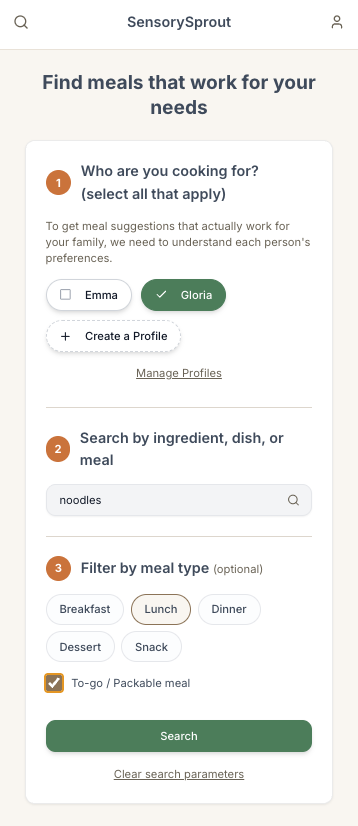
Meals That Work for the Whole Household
If divergence is the norm, the solution can’t be better recipes for one person. Planning has to account for everyone at the table.
The hypothesis: shift the unit of planning from the individual to the household.
This framing reflects what families actually want: not separate meals, but meals that respect everyone’s non-negotiables.
What This Doesn't Include
The solution deliberately avoids:
- AI-generated recipes. Generative AI is useful for exploration but carries unacceptable risk for real family use without deterministic constraint enforcement.
- Nutrition optimization. Clinical guidance is clear: calm, reliable intake comes before nutrition goals. Premature optimization risks destabilizing fragile routines.
- Behavior-change framing. The goal isn't to "fix" picky eating or expand preferences. It's to make dinner work as it is—tonight.
Trust Is the Gate—
Not a Growth Lever
In trust-sensitive domains, products don't fail gradually—they're abandoned after the first serious mistake.
For families managing sensory sensitivities, a single missed constraint or wasted meal can permanently disqualify a tool. "Try it and see" isn't viable when failure carries emotional cost and broken trust with a child.
That's why trust has to be treated as a prerequisite, not a growth lever. Every design choice follows from that constraint.
Design Principles
These principles emerged from discovery. Any viable solution must respect them.
Open Questions
The problem is validated. The solution hypothesis is not. These questions need answers before moving forward.
Will it work?
Do parents need full recipes, or is inspiration and guidance enough?
Can families complete household-level setup in a realistic timeframe?
Will example-based input surface constraints better than abstract descriptions?
Will families trust it?
Does showing why a recommendation fits actually increase confidence?
Will families try a recommended meal—or just browse?
What does it take to earn a second use?
Will it sustain?
Will parents rate recipes and provide feedback over time?
What unlocks willingness to pay—personalization? Tracking? Therapist connection?
Is B2C subscription viable, or does this need a B2B2C model?
Riskiest Assumptions
These beliefs shaped the solution direction. Validation will confirm, refine, or invalidate them.
- Belief: Families will complete profiles for everyone at the table, not just the constrained child.
- Why it matters: If parents only profile the "problem eater," the system can't recommend meals that work for the whole family.
- Failure mode: Setup feels like a special-needs workaround, not normal meal planning. Parents abandon before finishing.
- Belief: Parents recognize what won't work more easily than they can explain why.
- Why it matters: Abstract preference questions create friction and inaccuracy. Example-based flows surface real constraints faster.
- Failure mode: Parents with clear diagnoses or therapy experience prefer direct input and find example flows slow or frustrating.
- Belief: Families need to see why a meal fits—not just that it does.
- Why it matters: When failure carries real cost, transparency is a prerequisite for trying something new.
- Failure mode: If meals consistently work, families stop reading explanations. Transparency becomes friction, not reassurance.
- Belief: Families will accept "same meal, different preparations" rather than fully separate dishes.
- Why it matters: The core value proposition assumes families want to eat together—not just eat successfully.
- Failure mode: Parents find parallel prep paths more work than cooking two different things. The shared-meal framing solves a problem families don't actually prioritize.
What Comes Next
Validation will focus on the four riskiest assumptions—in order of dependency.
Household setup: Can families complete profiles for everyone in under 10 minutes? Does profiling feel like planning, not accommodation?
Example-based input: Do example flows surface accurate constraints faster than direct questions? Where do experienced parents get frustrated?
Trust through transparency: Does showing reasoning increase willingness to try a meal—or just add friction?
One base meal: Will families adopt "same meal, different prep"—or do they prefer simpler parallel cooking?
Each test is designed to invalidate the assumption fast. If household setup fails, the others don't matter.
The Governing Belief
In trust-sensitive domains, progress depends less on capability and more on perceived safety. A system that could do more but chooses to do less—visibly, explicably, reliably—earns the right to do more later.
If validation shows families want more automation or novelty than this framing allows, the constraint-first posture may be overcorrecting.